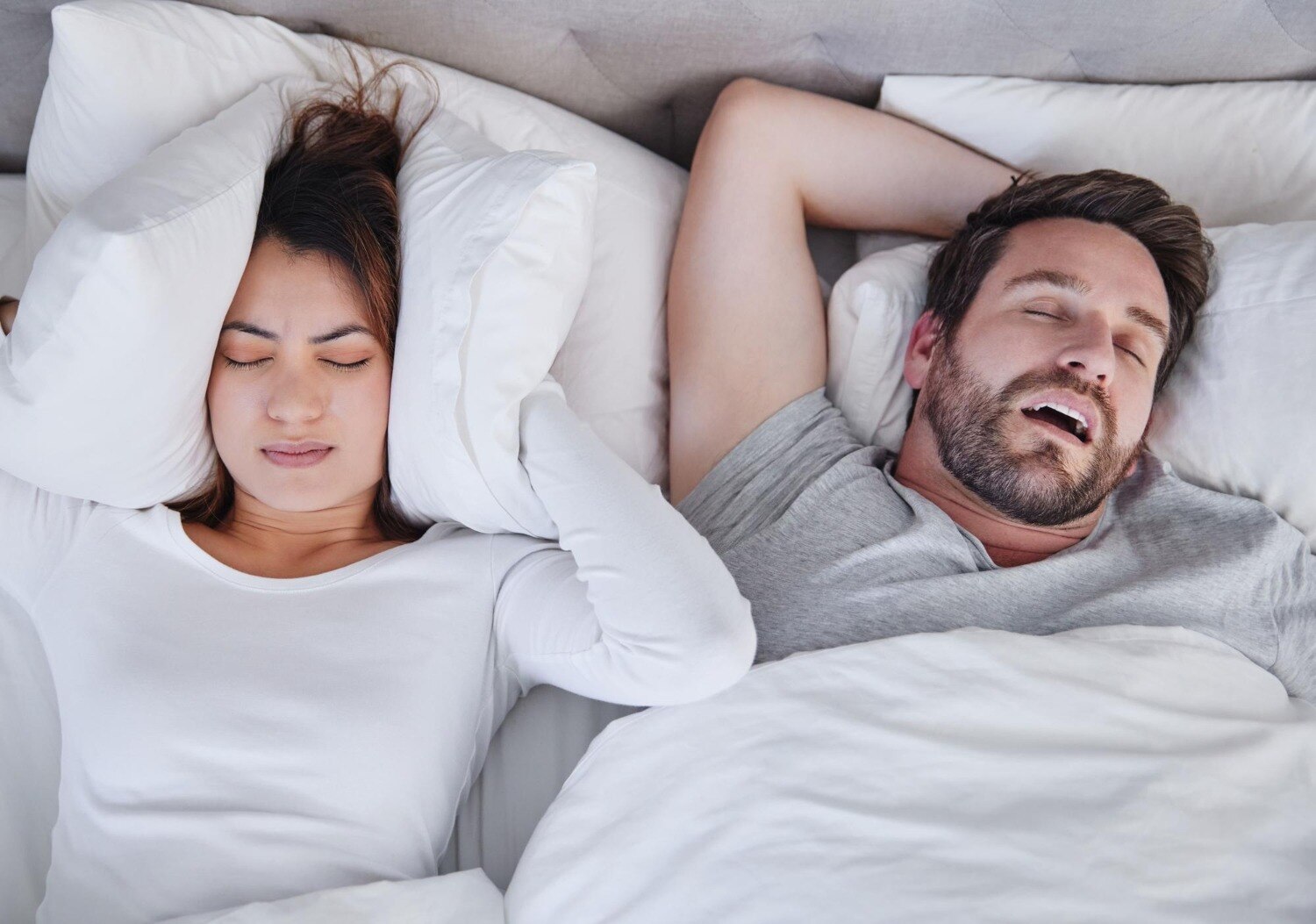
Loud snoring alone does not prove obstructive sleep apnea, but pauses in breathing, choking, morning headaches, severe sleepiness, or drowsy driving change the decision. You will be able to match your symptoms to a snoring assessment or a formal sleep apnea evaluation, understand which test fits, and prepare for the next step.
Key takeaways
- Choose a sleep apnea evaluation for pauses, choking, gasping, or severe daytime sleepiness.
- A home sleep test suits suspected obstructive sleep apnea without complex medical risks.
- Overnight polysomnography measures breathing, oxygen, brain activity, and sleep stages.
- Treat snoring after identifying its cause, not from sound alone.
Is your problem noisy breathing or interrupted breathing during sleep?
Habitual snoring calls for a basic snoring assessment when noisy breathing is the main problem and nobody has observed pauses, choking, gasping, or serious daytime impairment.
A snoring assessment in Mumbai can review your sleep history, bed-partner observations, alcohol or sedative use, nasal blockage, weight, blood pressure, and upper-airway findings without automatically requiring a sleep study.
Choose a more urgent sleep apnea evaluation in Mumbai if you have any of these warning signs:
- Breathing pauses noticed by a bed partner
- Gasping, choking, or waking with a sensation of suffocation
- Unrefreshing sleep, marked daytime sleepiness, morning headaches, or poor concentration
- Falling asleep while driving or struggling to stay awake at the wheel
- Treatment-resistant hypertension, atrial fibrillation, heart failure, or a previous stroke
- Obesity combined with loud snoring or other symptoms of airway obstruction
Drowsy driving is dangerous before any diagnosis is confirmed; do not drive when you are struggling to stay awake. Snoring is a symptom, not proof of obstructive sleep apnea, and quiet nights do not always exclude it.
A snoring assessment or sleep apnea evaluation in Mumbai should therefore focus on interrupted breathing, oxygen-related consequences, and daytime function—not noise alone.
What will a snoring doctor ask and examine?
A snoring doctor in Mumbai will look beyond volume: the key question is whether your airway repeatedly closes during sleep. Loud snoring without pauses or daytime impairment points toward primary snoring; interrupted breathing, oxygen-related symptoms, or marked sleepiness raises concern for obstructive sleep apnea.
Expect questions about:
- How long you have snored, whether it occurs nightly, and whether sleeping on your back worsens it
- Bed-partner observations of pauses, choking, gasping, restless sleep, or sudden awakenings
- Morning headaches, dry mouth, unrefreshing sleep, poor concentration, and unintended daytime naps
- Alcohol near bedtime, sleeping pills, sedatives, smoking, nasal sprays, and recent weight gain
- Nasal blockage, allergies, previous nasal surgery, and family history of sleep apnea
- Drowsy driving, atrial fibrillation, heart failure, stroke, or blood pressure that remains high despite treatment
The examination checks the features that narrow the airway or increase collapse risk.
| Finding | What it suggests | Why it matters |
|---|---|---|
| Persistent nasal blockage | Nasal resistance | Encourages mouth breathing and worsens snoring |
| High BMI or large neck | Increased airway-collapse risk | Strengthens the case for sleep-apnea testing |
| Small jaw, enlarged tonsils, large tongue, or crowded throat | Narrow upper airway | Makes obstruction during sleep more likely |
| Raised blood pressure | Possible sleep-apnea association | Resistant hypertension warrants prompt evaluation |
| Normal examination with noise only | Possible primary snoring | A sleep study is not automatically required without other warning signs |
Falling asleep while driving requires immediate safety action: do not drive until the sleepiness is assessed.
Which sleep test fits your symptoms: home testing or overnight polysomnography?
A clinician chooses a home sleep apnea test (HSAT) for an uncomplicated adult with a strong likelihood of moderate-to-severe obstructive sleep apnea. Attended polysomnography (PSG) is the better choice when the diagnosis is uncertain, symptoms are severe, or another sleep or medical disorder could affect the result.
| Option | What it measures | When it applies |
|---|---|---|
| Home sleep apnea test | Airflow, breathing effort, oxygen saturation, pulse, and often snoring or body position; it usually uses recording time rather than actual sleep time | Adults with suggestive symptoms and no major complicating condition, after clinical assessment |
| Attended polysomnography | Airflow, chest and abdominal effort, oxygen saturation, pulse or ECG, body position, snoring, brain waves, eye movements, muscle activity, sleep stages, and arousals | Suspected OSA with significant comorbidities, uncertain findings, insomnia, unusual breathing patterns, neuromuscular disease, or a negative HSAT despite persistent suspicion |
HSAT is not a screening test for every person who snores. It may underestimate severity because awake recording time lowers the calculated event rate, and it cannot reliably identify arousals or every form of sleep-disordered breathing.
PSG records actual sleep, so it calculates the apnea-hypopnea index (AHI) per hour of sleep; HSAT often calculates it per hour of recording.
A negative HSAT does not end a sleep apnea evaluation in Mumbai when witnessed pauses, choking, daytime sleepiness, or resistant hypertension remain. In that situation, ask whether attended PSG is needed.
How should you prepare, and how should you read the result?
Prepare for the test by preserving your usual sleep pattern rather than trying to create a “good” night. Follow the clinic’s instructions about medicines, and do not stop sedatives or other prescriptions without medical advice.
- Avoid alcohol and non-prescribed sleep aids on the study night unless your clinician tells you otherwise; both can change breathing and sleep stages.
- Record your usual bedtime, wake time, naps, nasal blockage and daytime sleepiness. Ask your bed partner to note pauses, gasping and sleeping position.
- Check that a home device has recorded every signal before accepting its report. Keep the sensor instructions and contact the clinic if it detached or produced a poor-quality trace.
A negative home sleep apnea test does not always exclude obstructive sleep apnea. Home testing often measures recording time rather than true sleep time, so awakenings can dilute the event rate; missed signals, REM-related apnea and positional apnea can also hide disease. Persistent symptoms after a negative or technically inadequate test call for attended polysomnography.
Read the apnea-hypopnea index (AHI) as one finding, not the diagnosis. An AHI of 5–14.9 is mild, 15–29.9 moderate and 30 or higher severe in adults, but oxygen-desaturation burden, central events, sleep position, REM sleep, signal quality, symptoms and other conditions can change its importance.
A sleep apnea evaluation in Mumbai should interpret the whole report; a snoring assessment in Mumbai may be enough when the clinical picture remains uncomplicated. Do not drive when sleepy, regardless of the eventual result.
What happens after the assessment: which snoring treatment options make sense?
Treatment depends on whether testing found airway obstruction, not on how loud the snoring sounds. Primary snoring without OSA calls for measures that reduce vibration; diagnosed OSA requires treatment that prevents repeated airway collapse and oxygen drops.
| Option | What it means | When it applies |
|---|---|---|
| Primary snoring measures | Address excess weight, alcohol or sedatives near bedtime, nasal blockage, and back-sleeping | Snoring is present but testing finds no OSA |
| Custom oral appliance | A dentist-fitted, adjustable device advances the lower jaw | Selected adults with primary snoring or OSA who prefer it or cannot tolerate PAP; dental follow-up is essential |
| PAP therapy | Pressurised air keeps the throat open during sleep | Commonly recommended for diagnosed OSA, especially with marked symptoms or cardiovascular risk |
| Surgery | Corrects a specific obstructing structure after examination | Considered when anatomy supports it and PAP or an oral appliance is unsuitable or unsuccessful |
Do not treat persistent snoring as cosmetic noise if there are witnessed pauses, choking, morning headaches, unrefreshing sleep, resistant hypertension, or drowsy driving. A negative home test also deserves review when symptoms remain; the test can miss events.
A snoring doctor in Mumbai can decide whether you need treatment for primary snoring or further testing. Dr. Pujan Parikh can help interpret the result alongside symptoms, oxygenation, blood pressure and medical history, rather than choosing therapy from the AHI alone.
Arrange a snoring assessment or sleep apnea evaluation in Mumbai when the diagnosis remains uncertain or daytime safety is affected.
Related services
Sleep Medicine Services Snoring Assessment & Management Snoring Assessment & Management View service → |
Sleep Medicine Services Sleep Apnea (Obstructive & Central) Diagnosis and Treatment Sleep Apnea (Obstructive & Central) Diagnosis and Treatment View service → |
Frequently asked questions
Do I need a snoring assessment or sleep apnea evaluation in Mumbai?
Choose a basic snoring assessment when noisy breathing is the main issue. Seek a sleep apnea evaluation if someone sees breathing pauses, choking, or gasping, or you have serious daytime sleepiness.
What does a snoring doctor in Mumbai ask and examine?
A snoring doctor asks about sleep sounds, witnessed pauses, morning headaches, daytime sleepiness, medicines, alcohol, nasal blockage, weight changes, and medical conditions. The examination may include your nose, throat, jaw, neck, breathing, and oxygen level.
Should I have a home sleep test or overnight polysomnography?
A home sleep test can fit adults with suspected uncomplicated obstructive sleep apnea. Overnight polysomnography is more suitable when symptoms are complex, another sleep disorder is possible, or a home test is negative but suspicion remains.
How should I prepare for a sleep apnea test?
Follow the clinic’s instructions, keep your usual sleep schedule, avoid alcohol, and record medicines you take. Ask how to attach, return, and troubleshoot the equipment before testing.
What happens after a snoring assessment?
Treatment depends on the cause and test result. Options include nasal treatment, positional changes, weight management, an oral appliance, CPAP, surgery, or treatment of another sleep or breathing condition.
Keywords